

iBOF® Endpoint Control
Poor endpoint control reduces yield & productivity, elevates tap [O] and increases slag FeO & tap alloy consumption. Tenova’s Endpoint Control Module utilizes off-gas analysis, velocity & temperature sensors, heat specific data and a fundamental real-time mass & energy balance model to accurately predict endpoint steel & slag chemistry.
Overview
To ensure a robust, low cost endpoint solution, the iBOF® Endpoint Control Module includes a real-time Mass & Energy (“M&E”) balance software that incorporates fundamental thermodynamic & kinetic equations to better model the non-equilibrium near-end of blow conditions when carbon, iron & phosphorous oxidation can occur concurrently.
Tenova’s patented NextGen® hybrid extractive/laser off-gas analysis technology, proprietary off-gas velocity, temperature and static pressure sensors and a PLC link provide all the measurements needed to close a precise real-time M&E Balance.
NextGen’s multipoint capability can reduces hardware, installation cost & maintenance by enabling continuous, simultaneous off-gas analysis on multiple BOF’s with just a single central cabinet.
NextGen® hybrid technology ensures ultra-fast analytical response times and no lost signals by combining Tenova’s highly reliable, industry proven extraction technology to clean the off-gas before using
self-calibrating lasers and other analytical devices to provide full spectrum CO, CO2, H2, O2, H2O & N2 analysis
Technical data
Reliable [C] & Temperature Endpoint control for Low Carbon Grades; by eliminating assumptions and statistical models, Tenova’s M&E Balance approach is capable of predicting endpoint carbon to within 0.01% and temperature within 17 °C on about 90% of low carbon heats thereby generating significant operating cost benefits. Typically, low carbon heat savings range from $1.00 - $1.25 per tls.
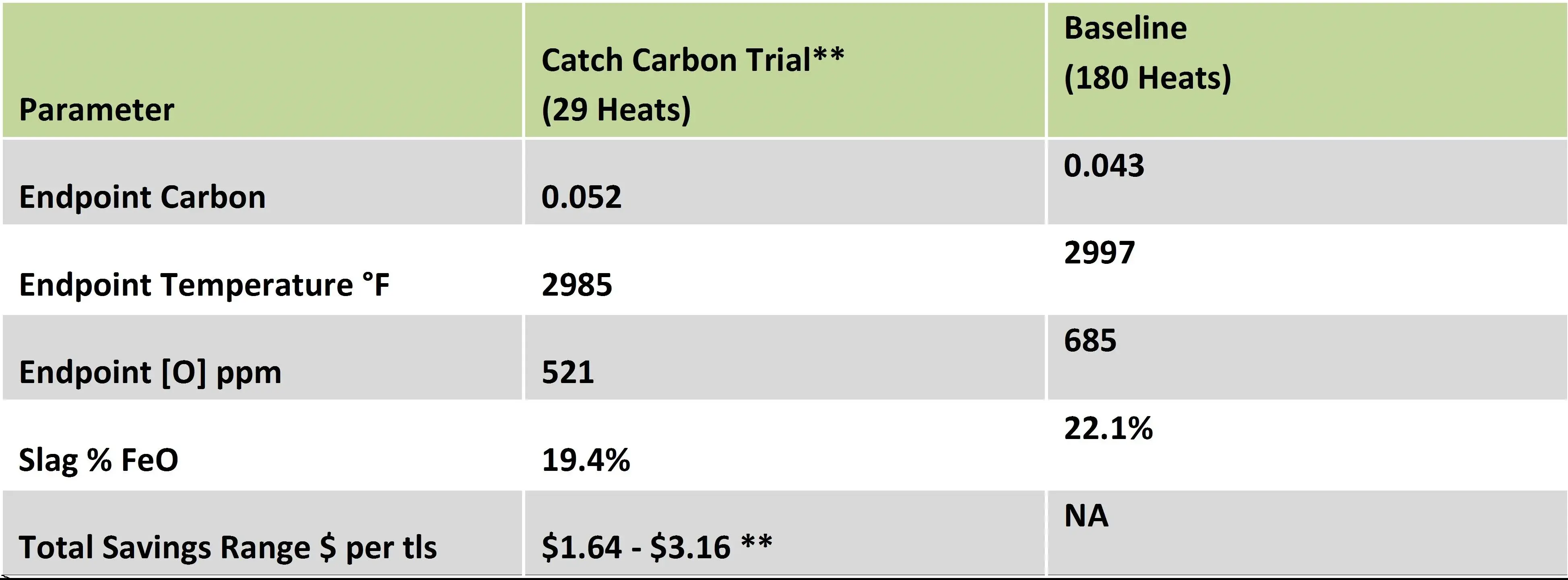
Catch Carbon Practice for Mid & High Carbon Grades; stopping a blow with precision at higher carbon levels is difficult; Tenova’s Catch Carbon Endpoint Detection system has demonstrated a 60% reduction in endpoint standard deviation on mid/high carbon grades thereby avoiding recarburization in the ladle, higher operating costs, higher tap oxygen levels and increased tap alloy consumption. Plant results confirm that using a 0.05% “Catch Carbon” practice instead of an 0.04% recarburization practice reduces endpoint [O] ppm and tap alloy consumption generating savings between $1.65- 3.15 per tls.
Complete Slag & Bath Chemistry prediction from start-to-end of heat: Tenova’s fundamental model predicts the evolution of both slag & steel chemistries from start-to-end of heat providing a valuable data base for i BOF® Digitalization advanced analytics & continuous improvement.
Improved Phosphorous Endpoint Control: Tenova’s Endpoint model predicts near-end of blow [P] for reduced phosphorous reblows
Automation
During Low Carbon heats, the iBOF® Endpoint control HMI provides clear, real-time “End-of-Blow” indicator either as an operator alert or as a closed-loop lance withdrawal
During high Carbon heats, iBOF® Endpoint facilitates catch carbon practice for 0.10%C heats
Calculates %C, %P, Temperature, Slag Analysis & Volume from start-to-end of the heat for significant savings
Environment
i BOF® Endpoint control module is designed to reduce GHG emissions and minimize yield losses
Digital
i BOF® Endpoint Control Module is a fully digitalized solution
Related Solutions